Guide
How to Clean Commercial Refrigerator Condenser Coils
How to clean the condenser coil on a reach-in or prep table: tools, steps, how often to do it, warning signs, and when a clogged coil means a service call.
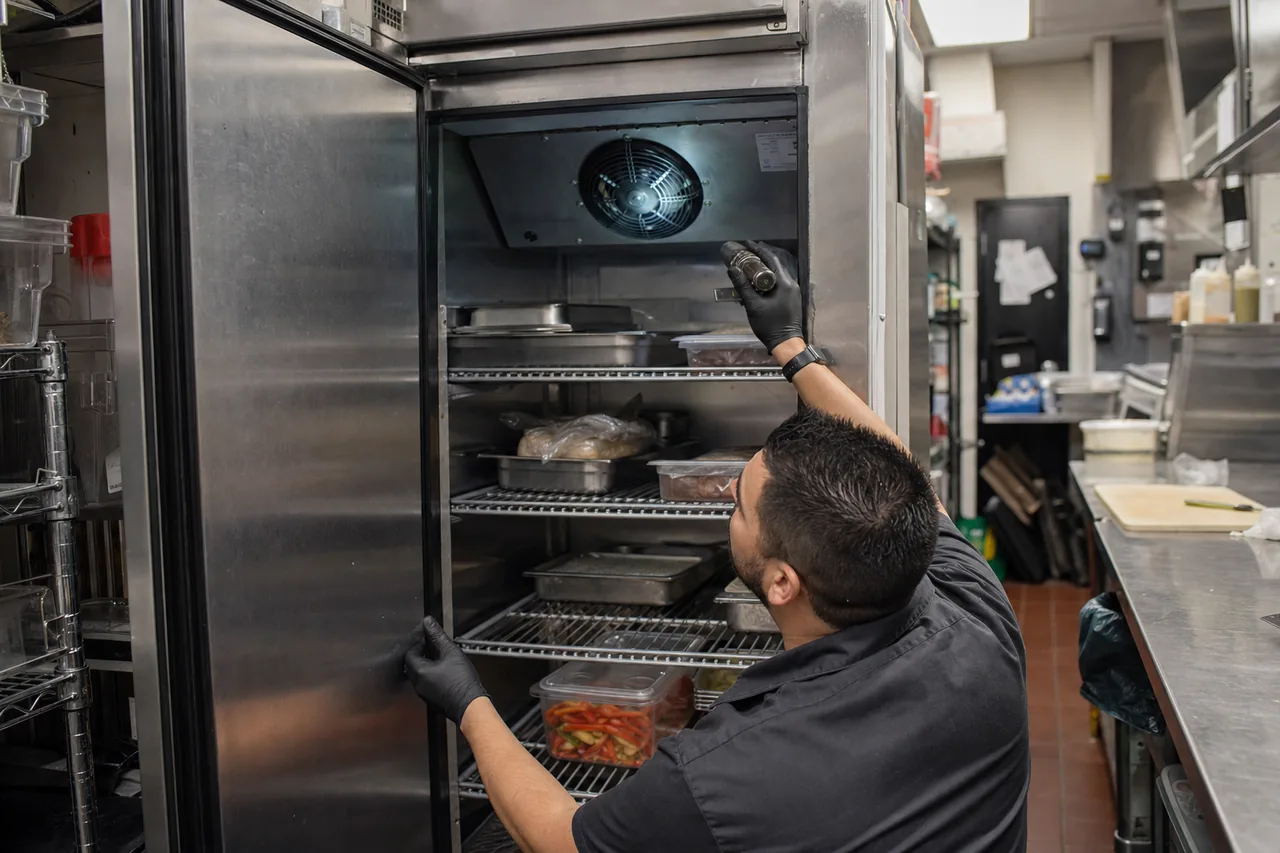
To clean commercial refrigerator condenser coils, cut the power, remove the grille over the condensing unit, loosen the dust and grease with a soft coil brush stroked along the fins, then vacuum it out, which takes about 20 to 30 minutes on a typical reach-in or prep table. In most restaurant kitchens the job belongs on the schedule every 30 to 90 days, and monthly for any unit near a fryer, griddle or flour station.
Skipping it is a common reason a cooler drifts above 41°F, the cold-holding limit a health inspector checks first.
What does the condenser coil actually do?
A refrigerator moves heat out of the cabinet and dumps it somewhere else. That somewhere is the condenser: copper or aluminum tubing wrapped in thin metal fins, with a fan pulling kitchen air across it. Hot refrigerant from the compressor gives its heat to that air and condenses back into liquid so it can cycle again.
Where the coil sits changes how it gets dirty. On a bottom-mount reach-in, such as many True models, it lives behind a kick plate at floor level, where mop water, lint and dust collect. Top-mount units, a common layout on Traulsen reach-ins, pull air from above the cabinet, where grease vapor from the cook line settles. Prep tables squeeze the coil into a tight compartment with little room for air.
How does a dirty coil fail under restaurant load?
Lint builds a felt-like mat across the face of the closely spaced fins, and airborne grease turns it into a sticky layer. Air cannot pass, so heat stays in the refrigerant. System pressure climbs, the compressor runs longer and hotter, and the box recovers slowly after every door opening.
During a busy dinner service, a reach-in on the line is opened again and again. A clean coil keeps up. A clogged one falls behind, and the cabinet creeps from the high 30s into the mid-40s by the end of the night, putting product at risk. Over months, the extra heat and run time wear out the compressor and condenser fan motor, the expensive parts.
New Rochelle sits on Long Island Sound, and kitchens near Echo Bay and the waterfront breathe salty air. Salt plus grease is hard on thin aluminum fins, so check those coils for corrosion as well as dirt.
How do you clean the coils step by step?
- Protect the food and cut the power. Unplug the unit or switch off its breaker; the condenser fan can start without warning.
- Remove the grille or louver panel. If the unit has a condenser filter screen, wash it and let it dry fully.
- Look before you brush. Note which way the fins run and check for bent fins, oily patches or white, powdery corrosion.
- Brush with the fins, never across them. Brushing across folds the fins over and blocks the airflow you are restoring.
- Vacuum the loosened debris with a brush attachment, keeping the hard nozzle off the fins.
- Blow it out from the back if you can reach it. Air pushed opposite the normal flow drives dirt out the way it came in. Wear eye protection and keep open food away.
- Degrease only when needed, with a no-rinse condenser coil cleaner. Never use a pressure washer, and keep spray off the fan motor and electrical box.
- Restart and verify. Reinstall the grille, restore power, confirm the fan spins, and check the thermometer in an hour or two.
Microchannel condensers, with flat tubes and very fine fins, need an even lighter brush. And leave clearance: a unit pushed tight to a wall, or a top-mount with boxes stacked on it, chokes airflow even with a clean coil.
What symptoms tell you the coil is already causing trouble?
| What staff notice | What it usually means | What to do |
|---|---|---|
| Cabinet reads 42°F or higher late in service | Coil cannot shed heat fast enough | Clean the coil, then log temperatures |
| Compressor runs almost nonstop | High pressure from blocked airflow | Clean it; if it continues, book a diagnosis |
| Unit trips its breaker or cycles off and on | Compressor overheating and cutting out | Service call; stop resetting it |
| Coil is clean but the box still runs warm | Fan motor, refrigerant or control fault | Service call |
| Ice on the coil inside the cabinet | Evaporator or defrost problem, not the condenser | Service call |
When is a dirty coil a service call?
If cleaning brings the cabinet back to 41°F or below within a couple of hours, the job is done. If not, the dirty coil was a symptom, not the cause: think weak fan motor, refrigerant leak, failing start component, or a compressor that overheated too often. Move product to a working unit and call before the next service.
Reach-in / prep-table refrigeration repair typically runs $250–$900, and a diagnostic / service call $95–$165. These are typical ranges; the firm quote is given on site after diagnosis. A walk-in compressor or sealed-system repair falls in a higher band, typically $1,200–$4,000. See repair pricing and commercial refrigeration repair for New Rochelle, Larchmont, Pelham and nearby towns. Air-cooled ice machines clog the same way; see ice machine repair.
New Rochelle Commercial Appliance Repair is an independent service, not manufacturer-authorized. Call (914) 809-9382.
Frequently asked questions
How often should restaurant condenser coils be cleaned?
Every 30 to 90 days for most reach-ins and prep tables, and monthly for units near fryers, griddles or flour. Put it on the same checklist as hood filter cleaning.
Can I use a pressure washer on the condenser coil?
No, a pressure washer flattens the fins and can drive water into the fan motor and controls. Use a no-rinse coil cleaner with the power off.
Why is my cooler still warm after I cleaned the coils?
A clean coil that does not fix the temperature points to another fault, such as the fan motor, a refrigerant leak or the compressor. Move food to a working unit and book a diagnostic.
Can kitchen staff handle coil cleaning themselves?
Yes, trained staff can do routine cleaning with the power off and a soft brush. Bent fins, oily residue on the coil, or a unit that still runs warm afterward are jobs for a technician.